

The North York Moors National Park Authority has carried out urgent works on Fylingdales Moor to stabilise and protect the nationally important archaeological site of John Cross Rigg, alongside efforts to safeguard the surrounding recovering habitats.
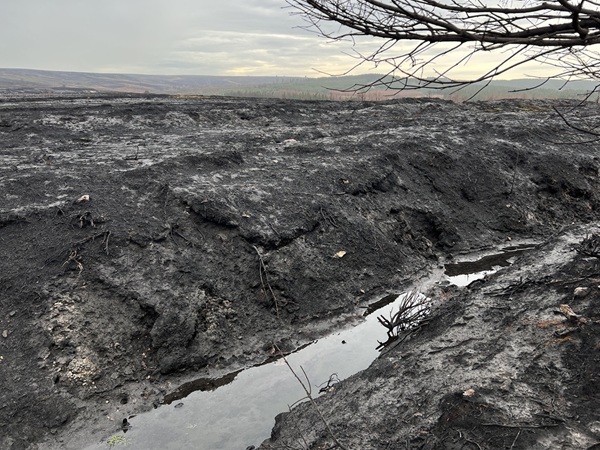
While last year’s wildfire was environmentally catastrophic - stripping vast areas of vegetation and both exposing and, in some places, removing vulnerable peat soils - it has also rendered the historic landscape ‘readable’ in a new way. Features previously concealed beneath heather have emerged with striking clarity, offering fresh insights into the area’s complex past. This increased visibility has however come at a cost; the loss of vegetation has left both habitats and heritage dangerously exposed.
The wildfire removed the root systems that normally bind and protect the peat. In the weeks of persistent heavy rain that have followed, significant wash-off of remaining soils has occurred, leaving some areas unstable and highly vulnerable to erosion.
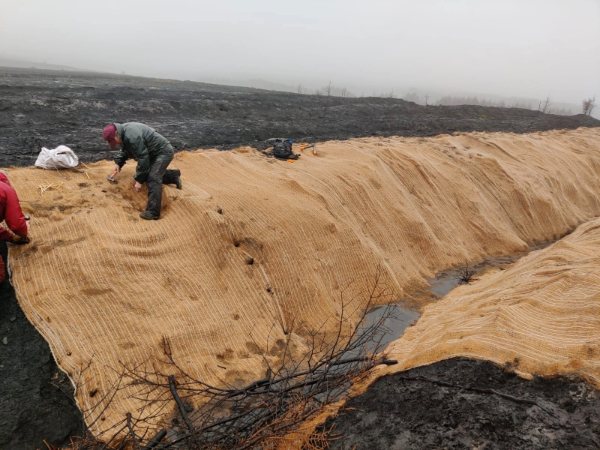
At John Cross Rigg – a prehistoric earthwork thought to have been constructed over several centuries - this effect of the fire has been plainly visible. Without protective soil and vegetation, sections of the monument were slumping and sliding, with erosion most evident along the banks and ditches. Without urgent intervention, the heavy rainfall would result in irreversible damage to the site.
To address the most at-risk areas, the National Park Authority has installed coir (coconut fibre) matting across vulnerable sections of the monument. These biodegradable blankets are being carefully laid over damaged slopes to help stabilise soils, reduce erosion, and create conditions in which vegetation can re-establish. The matting slows surface water run-off and provides temporary protection while natural recovery takes place.
Miles Johnson, Head of Historic Environment for the North York Moors National Park Authority said:
“For an archaeologist, it is remarkable to see the historic landscape of Fylingdales Moor revealed with such clarity, but that excitement is tempered by deep concern. The very exposure that allows us to understand these features more fully is now putting them at risk.
“We are working closely with Historic England to deliver emergency solutions to stabilise the most vulnerable areas while the moorland begins its long recovery. Installing coir matting is an immediate measure to protect the most seriously damaged sections and prevent further irreversible loss.
“The wider environmental impacts are equally concerning. Without vegetation to anchor soils, heavy rain is washing away peat, degrading water quality and increasing flood risk downstream. Our work is about protecting archaeology, habitats and the wider landscape together.”
The National Park Authority continues to monitor conditions across Fylingdales Moor and is working with partners to support landscape recovery and long-term resilience. This urgent work has been funded through grants from Historic England, the Environment Agency and North Yorkshire Combined Authority.
Alongside urgent measures to protect the historic environment, a draft three-year plan has been developed to guide the next phase of restoration. Work with the Yorkshire Peat Partnership will help shape peatland repair, including the re-establishment of sphagnum moss and cotton grass - two key peat-forming species that retain water, stabilise the peat and support the recovery of wet heath landscape.
Progress has also been made in installing fencing to allow the safe and controlled return of grazing, supported through the DEFRA Farming in Protected Landscapes programme, providing practical help for landowners, farmers and graziers whose livelihoods have been affected.
Further updates will be provided as restoration work progresses.
ENDS
Media contacts
Nina Beadle, Communications Officer, North York Moors National Park Authority
press@northyorkmoors.org.uk
01439 772700
The North York Moors National Park
The North York Moors is a beautiful landscape of stunning moorland, ancient woodland and historic sites. Created on 28 November 1952, it became Britain’s sixth national park. Covering an area of 554 square miles (1,436 square kilometres) the National Park has 26 miles of coastline, two national nature reserves, 840 Scheduled Monuments and over 3,000 listed buildings, attracting an estimated 9.03 million visitors a year.
The National Park has two visitor centres, Danby Lodge National Park Centre and Sutton Bank National Park Centre, providing opportunities for cycling, walking, eating, picnicking, shopping, crafts and wildlife-watching. The centre in Danby also houses the Inspired by… gallery, which features regularly changing exhibitions by artists who draw their inspiration from the North York Moors.
Last updated: 11 Mar 2026