

Reimagining the remarkable earthworks of Cawthorn Roman Camps
Nearly 2,000 years ago the sound of mattocks tearing through the earth thumped out across the south of the North York Moors. Hardened bodies of Roman soldiers ploughed through the soil, throwing up earthworks topped with wooden stakes. Surrounding them, the howls of warlike tribes simmering from the woodlands nearby...
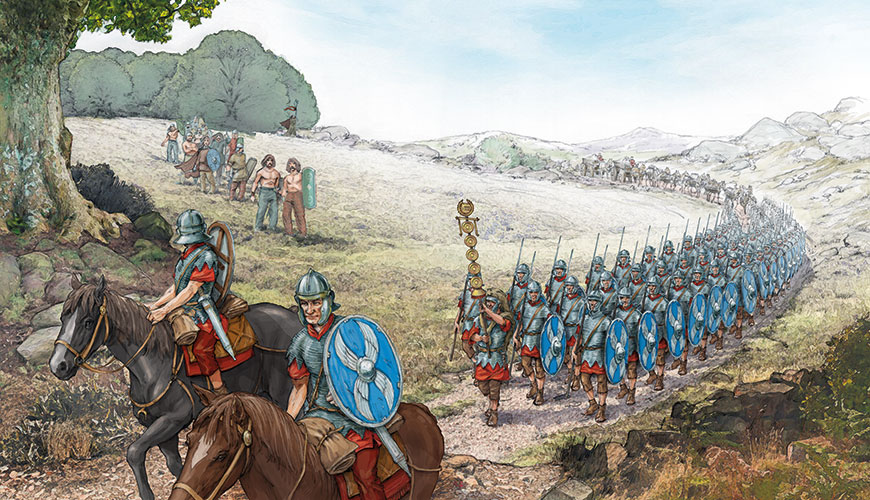
Experience what life would have been like for the soldiers of Cawthorn Roman Camps by heading out on a new illustrated trail!
Through a range of colourful interpretations and panels, this easy-going 1-mile trail offers you the opportunity to discover the most famous Roman site in the North York Moors.
About
The legions of the Roman Empire invaded Britain in AD 43 and in a few years they conquered the south of the country. At the time, much of what is now northern England was dominated by warlike tribes called the Brigantes.
When the Romans first occupied Britain they were content to let the Brigantes govern themselves. It wasn't until an anti-Roman rebellion broke out among the Brigantes in AD 69 that the Romans sent troops to occupy their territories.
The occupation began in AD 71. Roman forces advanced to York (Eboracum) and built a legionary fortress. From there they set out to conquer northern Britain.
During their campaign, they built a network of military roads stretching right across the region. And in strategic places along them, they built camps and forts – Cawthorn was one of these.
Long considered a group of military practise camps, it is now clear that the well-preserved earthwork remains include three military fortifications, including one fort with an annexe and one that was a temporary camp built to a very odd plan. The site really comes to life as you walk around the trail.
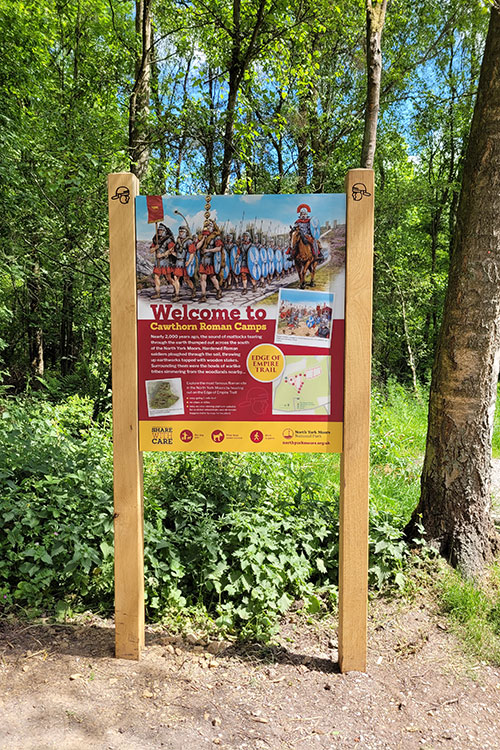 Trail information
- The walk starts in the far corner of the car park, next to the car park machine.
- Simply follow the marker posts showing a carved Roman legionary helmet.
- There are no steps or stiles, and most of the paths have a firm crushed aggregate surface and gentle gradients.
- The section from the car park directly to the viewing platform, as well as from posts 1 to 7 is suitable for assisted wheelchair users and families with more robust, all-terrain type buggies.
- Free entry, parking charges apply.