

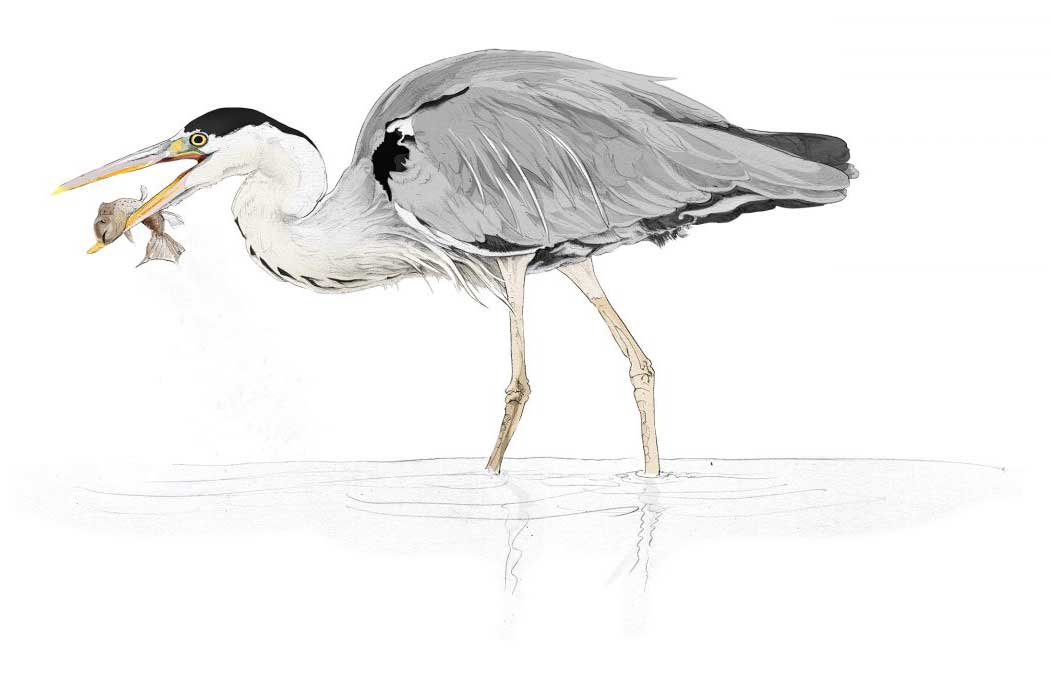
Ardea cinerea
Herons live near shallow, fresh water and can often be spotted close to rivers and streams, reed beds, lakes, reservoirs and gravel pits. During the winter months, herons can sometimes be seen by the coast in sheltered spots.
Herons are large wading birds. They have a long neck and a long, straight, yellow bill that looks like a dagger from the side. In Britain we have the Grey Heron. It is almost a metre in length and weighs up to 2kg. It is mostly grey and white in colour, with a black crest on its head and long yellow legs. Easy to spot when they are flying, herons flap their large wings slowly and keep their head tucked in to their body. They make a harsh ‘craank’ call.
The heron’s long legs help it to wade easily in shallow water, where it feeds on fish, amphibians, snails and crabs. It uses stealth, patience and fast reactions to catch its prey. Herons can often be seen standing very still in the water for long periods, watching and waiting. While it waits, its neck will form an S shape. If a fish swims close enough, the heron tips forward quickly and stretches its neck out to stab its prey. Herons swallow small fish whole and take larger fish back to land to eat. When trying to attract a mate, herons put on impressive displays, arching their long necks upwards. Herons pair for life, building their nest together, often in a tall tree but sometimes on the ground. The nest will be a large platform of twigs. The female lays 3 to 5 eggs between February and April. Although they tend to nest in groups, herons hunt alone.
The heron is not considered to be under threat but it is important to keep rivers and streams clean and healthy in order to supply fish for these magnificent birds.