

This project sees farmers, an independent agronomist, Leeds University and Innovative Farmers working together to develop and trial new and varied grass seed mixes.
The grassland sustainability project brings together seven farmers from the North York Moors National Park and three from the Howardian Hills National Landscape, Fraser Hugill as the lead farmer and applicant, Karen Stanley from the Yorkshire Farming and Wildlife Partnership, Leeds University, independent agronomist Jonathan Holmes and Innovative Farmers.
Previous work had identified cocksfoot grass as a valuable grass species to be included in grass leys due to its deep rooting and ability to thrive in more challenging environments without the need for high levels of artificial fertilisers. The group of farmers were keen to test the performance of cocksfoot leys by establishing some field scale plots to compare cocksfoot with more “off the shelf” ryegrass leys.
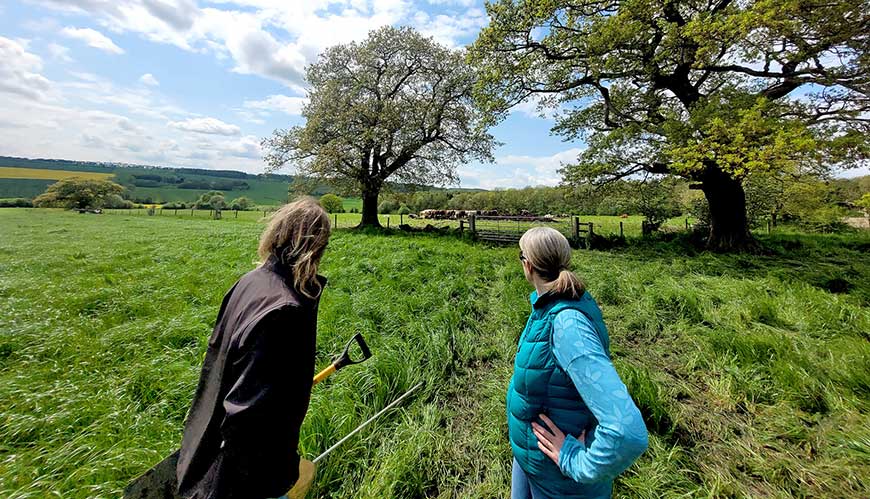
In year one of the project, FiPL supported environmental baselining by Leeds University and Jonathan Holmes, who visited all the farms to provide independent agronomy advice and advise on the best bespoke cocksfoot seed mixes to establish the leys. Year 2 support was provided by FiPL alongside Innovative Farmers, to begin to monitor the performance of the cocksfoot leys against the off the shelf mixes. The team looked at both productivity and the impact on the environment, as they hoped the deeper rooting nature of cocksfoot would improve soils and benefit water infiltration and the building of soil carbon.
2023/2024 was challenging both in terms of getting the plots established and the impact that the very wet winter had on the leys. It was observed that the cocksfoot was less tolerant of the extreme wet winter than ryegrass. It was also observed that cocksfoot was more dominant under trees where it is drier so with the move to wood pasture and agroforestry this was a valuable observation to consider further.
The real success of this project was the bringing together of farmers and researchers to share experience and apply those experiences at a field scale relevant to the North York Moors and Howardian Hills landscape.
Management Plan
This project supports the following management plan objectives:
 Outcome 1: A resilient landscape at the forefront of addressing climate change and nature recovery.
Objective 1: Reduce carbon footprint.
Objective 4: Protect, restore and improve soils across the National Park.
 Outcome 2: A nature rich, more biodiverse landscape.
Objective 7: Restore wilder and more naturally functioning ecosystems.
 Outcome 4: A place that lifts the nation’s health and wellbeing.
Objective 12: Create specific, targeted opportunities to improve mental and physical health and well-being by connecting people with nature.
 Outcome 5: A place that supports a diverse and innovative low carbon economy.
Objective 19: Maintain a strong and viable farming and land management community that delivers more for climate, nature, people and place.