
A brief history of the Medieval period
The Medieval period runs from the 5th - 14th Century CE. It is often divided into early and late Medieval categories. The history we uncover in Raiding the Bank generally sits within the later category, post 1066. This period was shaped by kingship, faith, and feudal life. Castles and cathedrals dominated landscapes, while farming villages sustained society. Power shifted through conquest, plague, and rebellion, forging a world defined by hierarchy and devotion.
Hood Hill
The Castle on the Ridge
High on the slopes of Hood Hill, an 11th Century earthwork marks the site of a Motte and Bailey castle. A ‘motte’ is a conical mound topped with a defensive tower; a ‘bailey’ is a fortified courtyard built alongside it. Hood Hill’s castle was unusually long and narrow due to the confines of the ridge. Local folklore calls the track between Hood Hill and Roulston Scar the ‘Thieves’ Highway,’ which may be an allusion to robber-baron Sir Gosceline D’Eyvill and his band of outlaws who occupied the castle in the early 14th Century.

The Battle of Byland
Two Kings in conflict
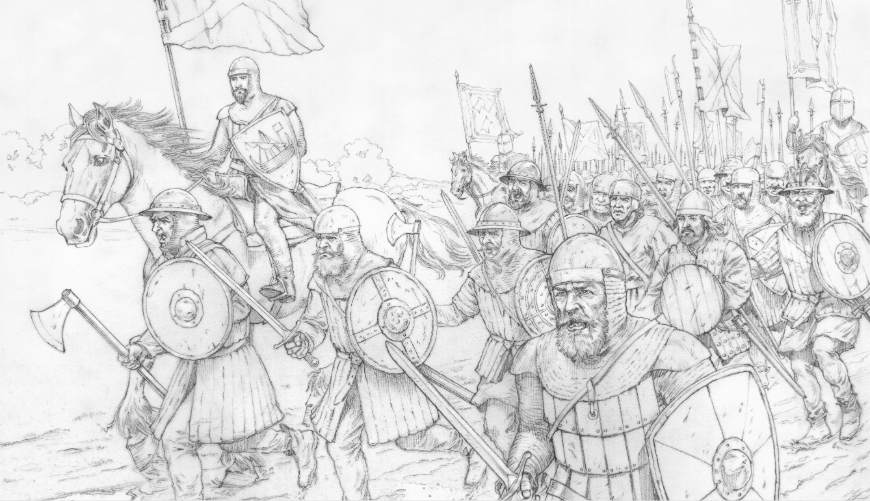
On 14th October 1322, King Robert the Bruce led a Scottish force of around 5000 men in a surprise overnight march from Northallerton. The plan was to seize the vital pass at Sutton Bank. Arriving at dawn, they found it already held by a strong English force under King Edward II. Watching on from the ridge, a bystander would have seen the attacking force streaming into the valley below. Although this would have been a daunting sight for the defending English, they held a commanding position. As the Scots began their ascent, the Battle of Byland commenced.
The move that changed the battle
As the Scots launched their assault on Sutton Bank, they became locked in brutal hand-to-hand combat. To break the deadlock, King Robert sent a division beneath the cliffs to flank the English via two gullies – Boar’s Gill and Hell Hole. Their path to attack the defending English passed this very spot. Local tradition suggests an English counterattack was defeated just east of here on Shaw’s Moor, about half a mile north of what is still known as ‘Scotch Corner’ in commemoration of this action.