

North York Moors Local Plan (2026–2041)
Project Plan
Version: 3
Date: 29 June 2026
Latest stage: Notice to commence Plan preparation was announced on 29 June 2026.
Next Stage: We intend to complete the first gateway self assessment in October 2026 and consult on a draft plan in May 2027 (if not, earlier).
A summary of the Plan timetable can be found here.
This CSV file contains the information above and will be updated when changes have been made to the timetable and when milestones have been met. This CSV file contains information on the title, and start and end dates of the current and forthcoming Local Plan. Data within both files is being provided to government under the Open Government Licence.
1. Purpose of this document
Local plans must be reviewed every five years. The current North York Moors National Park Authority Local Plan was adopted in July 2020 hence review is due.
This Project Initiation Document (PID) sets out definition, scope, management and deliverables of this review. It follows the format set out in the Planning Advisory Service’s PID template.
2. Project scope
Role of the Plan: As a local planning authority (LPA), we have a statutory duty under both the Planning and Compulsory Purchase Act 2004 and amendments made by the Levelling Up and Regeneration Act 2023 to prepare and adopt a Local Plan. The Local Plan will form part of the North York Moors National Park Authority’s Development Plan.
Objectives:
- Refresh development management policies with updated evidence.
- Align with emerging national development policies and the North York Moors National Park Management Plan.
- Address priorities for 2025–2040 including landscape, climate change, nature recovery, housing, and tourism.
- Incorporate Minerals and Waste Policies into the Local Plan.
Scope:
- Geographical: North York Moors National Park
- Time horizon: 2025–2040
- Focus: targeted policy updates, not a wholesale rewrite
Key deliverables:
- Updated evidence base (housing, landscape, environment)
- Initial ‘Current Thinking’ options document
- Draft plan
- Supporting evidence for consultation and examination e.g., Topic Papers
- Completed Strategic Environmental Assessment and Habitats Regulation Assessments
- Adopted Local Plan (2025–2040)
3.Related authority projects
- National Park Management Plan
- Nature Recovery Plan
- Climate Change Plan
- Local Cycling and Walking Investment Plan
4. Other plans that will be prepared
- North York Moors National Park Design Code
5. Plan timeline
The Government has changed the way Local Plans are prepared. New regulations, which came into force on 25 March 2026 set out this new process. Guidance is also available.
After a four month 'scoping stage' plans are expected to be prepared within 30 months. 3 'gateway assessments ' will be hold prior to the plan being submitted to Government for examination.
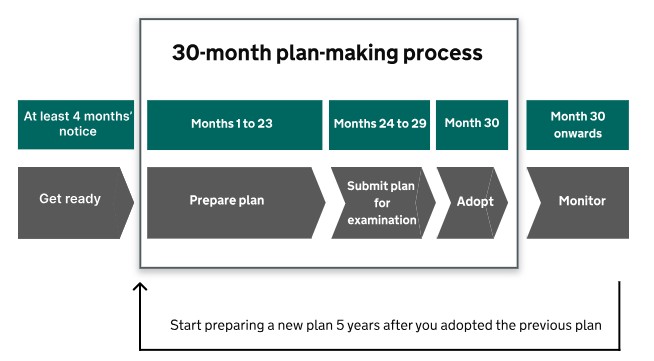
The four month scoping stage will begin in July 2026. This will include the publication of our 'First Steps' documents, which will include a 'current thinking' assessment of what changes might be needed, a call for sites, and draft vision, a policy by policy analysis of our current plan and a scoping report for the Environmental Assessment.
For the North York Moors draft Local Plan this means:
| Month | 29 Jun-26 | Notice of intention to prepare a plan & publish scoping/vision material for comment. |
|---|---|---|
1 | Jul-26 | Scoping consultation – ‘First Steps’ |
3 | Sep-26 | Plan visioning and strategy development |
4 | Oct-26 | Gateway 1 Self-Assessment and start of Plan preparation |
7 | May-27 | Engagement on proposed plan content and evidence (Round 1) |
15 | Jan-28 | Gateway 2 Assessment |
16 | Feb-28 | Consultation on proposed local plan (Round 2) |
24 | Oct-28 | Gateway 3 Assessment |
25 | Nov-28 | Submission |
27 | Jan-29 | Examination |
31 | May-29 | Adoption |
In more detail, for the North York Moors draft Local Plan, this means:
1. Pre-commencement stage
Stage 1a Notice of intention to prepare a plan/publish scoping documents
What will happen? Scoping and early participation. We will publish a local plan timetable on the same day or earlier. This is the formal start of the minimum 4-month notice period. The notice must be given publicly and set out where the timetable is published.
When? On 29 June 2026.
Outputs: As part of ‘First Steps’ early engagement:
- A Notice of Intention to Commence Local Plan Preparation
- This Project Initiation Document, setting out scope, issues, project management, risks, resourcing, and the approach to engagement
- A Scoping Document setting out key issues and asking for views (the ‘Current Thinking- Document’)
- Options for a draft vision for the Plan
- A policy-by-policy analysis of policies that may need to be reviewed or deleted, particularly in light of a new National Planning Policy Framework
- A call for sites
- A Sustainability Appraisal Scoping Report
We will also notify the Planning Inspectorate of our intention to create a new plan at this stage.
Stage 1b Gateway 1 – Self assessment
What will happen? The Authority will then publish an assessment of its preparedness to commence plan-making. The 30-month timetable commences at this stage.
When? Before 31 October 2026.
Outputs: A self-assessment summary using the Government’s template, including:
- Proposed scope of the plan and identifying the evidence required to create a sound plan
- Summary of responses to the ‘First Steps’ scoping consultation
- Scoping of relevant SEA requirements
- Review of the Project Initiation Document, including:
- Project management, governance, risks to delivery and resourcing to deliver against the local plan timetable
- The overall approach to engagement with communities and stakeholders, including statutory bodies, throughout the plan preparation process
2. Early plan-making stage
Stage 2a Plan visioning and strategy development
What will happen? We will publish a summary of the scoping consultation. We will start to develop and assess spatial strategy options and refine the draft vision and aims. We will undertake a Sustainability Appraisal / SEA of reasonable alternatives. We will continue the site assessment and selection process. Identify preferred and alternative spatial strategies. We will continue to develop the evidence base.
When? September 2026 – April 2027
Outputs:
- Summary of responses to the scoping stage
- Establishment of the vision, aims and objectives of the plan
- Spatial options and topics to be covered in local policies, supported by the Sustainability Appraisal
Stage 2b Round 1 engagement
What will happen? A mandatory statutory consultation.
When? May 2027 – June 2027
Outputs: Draft documents for consultation
Stage 2c Round 1 engagement – summary of responses
What will happen? We will publish a summary setting out the main issues raised and how they have been considered.
When? July 2027 – August 2027
Outputs: An engagement report
3.Post-gateway 1 work and first consultation
Stage 3a Finalise the preferred spatial strategy and draft policies
What will happen? We will complete site assessment and selection, agree on a preferred spatial strategy and update the Sustainability Appraisal. We will begin drafting the full local plan document.
When? August 2027- January 2028
Outputs: A draft plan with accompanying evidence.
Stage 3b Second gateway assessment
What will happen? We will seek the opinion of the Planning Inspectorate for observations and advice
When? January 2028
Stage 3c Approval to publish draft proposed local plan for consultation
What will happen? We will submit a report to the planning committee and/or full Authority to agree the proposed plan; policies map and all supporting documents for publication.
When? 3 February 2028
Outputs: Decision to undertake Round 2 consultation.
Stage 3d Round 2 consultation
What will happen? A mandatory statutory consultation. Minimum six-week period.
When? February 2028 – March 2028
Outputs: We will publish and invite comments on a complete draft plan, policies map and all supporting documents.
Stage 3e Round 2 consultation – summary report
What will happen? We will collate and publish a summary of Round 2 consultation responses
When? April 2028
Outputs: A consultation report
Stage 3f Update the Plan & and prepare submission documents
What will happen? We will prepare a statement of compliance, a full representations schedule, an updated evidence base, a schedule of proposed modifications (if any), and a policies map.
When? April 2028 – September 2028
Outputs: A set of submission documents
Stage 3g Third external gateway assessment
What will happen? The Planning Inspectorate will assess the soundness of our draft plan and whether it has been prepared under the correct legal stages and tests. Four weeks maximum, six in exceptional circumstances.
When? October 2028
Outputs:
- Procedural and legal requirements met
- Regard to be had to observations and advice at Gateways 1 and 2
- Evidence prepared as proposed, and any previously identified gaps addressed.
- Relevant SEA was published, including an explanation of compliance with national requirements.
- Summary of representations available
- Digital and data requirements met (including policies map)
- Nationally defined templates are used, where appropriate
- Engagement activities undertaken in line with the Project Initiation Document.
- SDS general conformity statement prepared (where relevant)
- Practical readiness for examination (e.g., venue identified for hearings, etc.)
4.Submission and Examination
Stage 4a Submit the Plan to the Planning Inspectorate
What will happen? We will submit the local plan, policies map, all supporting documents, statement of compliance and schedule of representations.
When? October 2028
Stage 4b Examination of our draft Plan by the Planning Inspectorate
What will happen? An Inspector will be appointed. The Inspectorate reviews submission documents. A pre-examination meeting is held and a programme officer is appointed by the Authority.
Inspector-led hearings will test the soundness of the plan against NPPF tests. Key strategic matters are considered early. Evidence will be tested. The Inspector will prepare a report on whether the draft Plan is sound and whether any main modifications will be needed to make it so.
When? November 2028 - March 2029
Stage 4c Issuing of the Inspector’s Report
What will happen? The Inspector prepares a report. We fact-check the report for factual accuracy. The Authority considers and formally agrees to any recommended main modifications.
When? April 2029
Stage 4d Adoption
What will happen? The Inspector prepares a report. We fact-check the report for factual accuracy. The Authority considers and formally agrees to any recommended main modifications. The Plan is adopted by the Authority.
When? By 14 May 2029
This assumes:
- A six-month examination period is set out in the Government’s proposed new system. It is possible that this period could be reduced on the basis that, as a National Park Authority, the level of representation is likely to be lower than for most local planning authorities. However, we have kept to the six months to add an element of contingency.
- There are also two key assumptions beyond the control of the Authority – that gateway assessors will be available and that an Inspector will be available shortly after submission.
5. Summary of key milestones for the Authority:
DPWG = Development Plan Working Group.
Milestone | Date |
Overview of draft Project Initiation Document and Policy by policy analysis documents. Initial discussions around housing policy. | DPWG – 13 January 2026. |
Agree to start Plan review and notify/Member input into ‘First Steps’ document | DPWG – 10 March 2026. |
Member input into ‘Current Thinking’ document | DPWG – 18 May 2026 |
Clearance of ‘First Steps and ‘Current Thinking’ document (Round 1) | National Park Authority – 29 June 2026 |
Member input into the draft Plan | DPWG – 10 November 2026 |
Member input into the draft Plan | DPWG – 8 December 2026 |
Member input into the draft Plan | DPWG – 12 January 2027 |
Member input into the draft Plan | DPWG – 9 March 2027 |
Clearance of vision, strategy, options consultation | Planning Committee – 13 May 2027 |
Member input into the draft Plan | DPWG – 11 August 2027 |
Member input into the draft Plan | DPWG – 12 October 2027 |
Member input into the draft Plan | DPWG – 14 November 2027 |
Member input into the draft Plan | DPWG - 11 January 2028 |
Clearance of ‘draft Plan for consultation (Round 2) | Planning Committee – 3 February 2028 |
Member input into the draft Plan | DPWG – 9 May 2028 |
DPWG to agree to the submission of the draft Plan | DPWG - 11 July 2028 |
Agreement to submit the Plan to the Secretary of State | Planning Committee – 8 September2027 |
Submission to the Secretary of State | October 2028 |
Hearings start | November 2028 |
Inspector’s Report Received | February 2029 |
Plan adopted | Planning Committee – 10 May 2029 |
6. Project roles
Project Sponsor: Chris France, Director of Planning
Project Manager: Paul Fellows, Head of Strategic Policy
Project Team: Paul Fellows, Clair Shields (Planning/Policy Officer)
Plus, support from the Geographical Information System specialist, Legal, Comms, and Development Management Team.
Member support and reporting:
Development Plan Working Group. Chair: Malcolm Bowes.
Decision-making bodies:
Planning Committee, National Park Authority
Reporting
Regular Senior Management Team project updates.
7. Resources & Budget
Internal resources:
Planning Policy Team (~1.8 FTE).
Head of Strategic Policy: Paul Fellows (1 FTE)
Planning Officer Clair Shields (0.8 FTE)
GIS, legal, comms – as required
Funding sources:
All funding for the Local Plan will come from the Authority’s allocated budget.
There are two main external costs:
1. External consultancy support to build up the evidence base.
Total estimated cost of evidence base: £57,100.
The following elements of the evidence base will be created in-house or are not required:
- Strategic Environmental Assessment - Internal
- Infrastructure Study – Internal
- Employment Study – not required.
The following elements of the evidence-based will need to be sourced from consultants:
- Viability Assessment – External consultancy required, to be procured. Estimated cost: £25,000
- Habitats Regulation Assessment – External consultancy required, to be procured. Estimated cost: £6,500
- Housing Needs Study - External consultancy required, completed. Cost: £5,600
- Gypsy and Traveller Assessment - External consultancy required, to be procured jointly with North Yorkshire Council. Estimated cost: £5,000
- Strategic Flood Risk Assessment - External consultancy required, to be procured jointly with North Yorkshire Council. Estimated cost: £10,000
- Open Space Assessment - External consultancy required, work underway jointly with North Yorkshire Council. Estimated cost: £5,000
2. Local plan examination. Estimated cost of examination: £54,685
We have estimated that £44, 685 will be required for 30 days of the Inspector’s time at £993 per day (including preparation and report writing)
We have factored in a Programme Officer salary estimated at 4 months of £10,000.
Total external costs: £111,785
8. Stakeholder Engagement
An engagement plan has been produced. (see end of this page) In summary, the following stakeholders have been identified.
- Statutory consultees: Environment Agency, Natural England, Historic England, Highways England
- Surrounding councils (North Yorkshire Council, Redcar and Cleveland Borough Council), Environment bodies
- Local stakeholders: Residents, parish councils, community groups, developers, businesses
- Stakeholders registered on the development plan mailing list. To join, email policy@northyorkmoors.org.uk
9. Risk Management Plan – Version 1
The purpose of this plan is to assess potential risks that may hinder or threaten the production of a new local plan. This Plan will be periodically reviewed by the Local Plan Team and the Development Plan Working Group (DPWG). The level of risk is assessed on an ongoing basis, and mitigation strategies are set out with clear ownership/responsibilities attached. Risks are identified and are marked as follows:
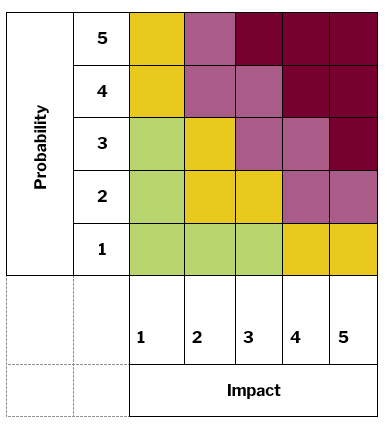
Probability: Almost certain – 5. Likely -4. Possible – 3. Unlikely – 2. Almost impossible – 1
Impact: Severe delay/abandonment – 5. Significant delay – 4. Moderate delay – 3. Minor delay – 2. No issues - 1
Overall score:
1-3 - Insignificant
4-6 - Moderate
7-12 - Significant
13-25 – High
Summary
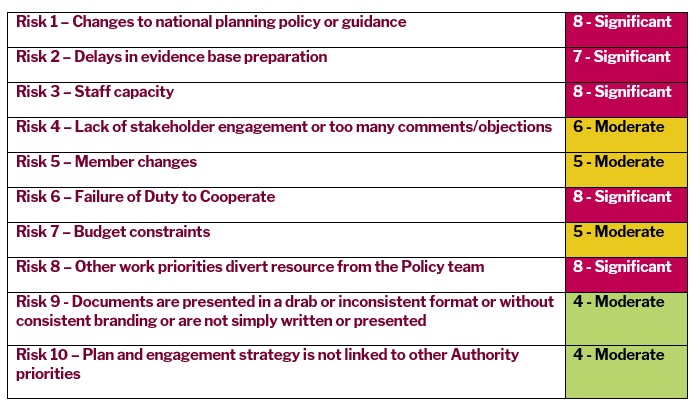
Risk 1 – Changes to national planning policy or guidance
Description: Updates to NPPF or government policy/legislation affecting plan content. A draft NPPF was published in December 2025 and we are awaiting the final version. As it contains National Development Management Polices (NDMPs) which cannot be replicated in Local Plans there is a significant risk of NDMPs affecting plan content. There is also uncertainty on the future of both Strategic Environmental Assessment and Habitat Regulation requirements.
Probability: Likely (4)
Impact: Moderate delay (4)
Overall risk: 8 (Significant)
Mitigation: Track government announcements, allow timetable flexibility, review implications promptly, and seek government advice if needed.
Owner: Head of Strategic Policy
Risk 2 – Delays in evidence-based preparation
Description: Delays in preparing key evidence (e.g., housing needs assessment, flood risk assessment, open space studies, etc.), or absence of evidence. Much of the evidence will come from studies commissioned by North Yorkshire Council, to which this Authority will co-fund and help manage.
Probability: Possible (3)
Impact: Minor Delay (4)
Overall risk: 7 (Significant)
Mitigation: Commission studies early, monitor progress regularly, maintain contact with consultants and North Yorkshire Council, and include contingency time in the project plan.
Owner: Head of Strategic Planning
Risk 3 – Staff capacity
Description: Turnover of planning policy staff, insufficient capacity, absence through sickness or key staff taking holiday/leaving holiday entitlement to the end of the year.
Probability: Unlikely (3)
Impact: Significant delay (5)
Overall risk: 8 (Significant)
Mitigation: Recruit temporary staff, succession planning, cross-train team members, and manage leave so it does not overlap or be left to the end of the year.
Owner: Head of Strategic Planning
Risk 4 – Lack of stakeholder engagement or too many comments/objections
Description: Failure to engage with stakeholders, significant opposition delaying consultation or adoption.
Probability: Unlikely (3)
Impact: Unlikely (3)
Overall risk: 6 (Moderate)
Mitigation: Conduct early and ongoing engagement, clear communications strategy, maintain transparent consultation records, and respond to representations fully. Consider temporary staffing if far more comments than anticipated.
Owner: Head of Strategic Policy
Risk 5 – Member changes
Description: Changes in members overseeing the project.
Probability: Unlikely (3)
Impact: Minor delay (2)
Overall risk: 5 (Moderate)
Mitigation: Maintain notes from Development Plan Working Group meetings, carry out member training, and induction of new members.
Owner: Chief Executive.
Risk 6 – Failure to cooperate with neighbouring Local Planning Authorities
Description: Not meeting the requirement to cooperate with neighbouring authorities.
Probability: Unlikely (3)
Impact: Significant delay (5)
Overall risk: 8 (Significant)
Mitigation: Hold regular joint officer meetings, formal Memoranda of Understanding, and escalate disagreements to Members early.
Owner: Head of Strategic Policy
Risk 7 – Budget constraints
Description: Insufficient budget affecting plan delivery.
Probability: Unlikely (3)
Impact: Minor delay (2)
Overall risk: 5 (Moderate)
Mitigation: Review resource plan regularly, seek additional funding if required, and prioritise critical workstreams.
Owner: Finance & Planning
Risk 8 – Other work priorities divert resources from the Policy team
Description: Other projects or requirements for statutory work to be undertaken reduce the amount of time available to produce the Local Plan. Specifically, the Management Plan will need to be reviewed in 2027, and the Design Code has yet to be completed.
Probability: Possible (4)
Impact: Significant delay (4)
Overall risk: 8 (Significant)
Mitigation: Spend time when drafts are out for consultation to prioritise other work. Consider how to divert time spent by the policy team on Management Plan drafting.
Owner: Head of Strategic Policy
Risk 9 - Documents are presented in a drab or inconsistent format or without consistent branding, or are not simply written or presented
Description:
Probability: Unlikely (3)
Impact: No issues (1)
Overall risk: 4 (Moderate)
Mitigation:
Owner: Head of Strategic Policy, with the Comms Team.
Risk 10 – The plan and engagement strategy are not linked to other Authority priorities
Description: The Plan is written ‘in a vacuum’, and insufficient internal consultation takes place to make sure the Plan reflects wider area Authorities.
Probability: Unlikely (3)
Impact: No issues (1)
Overall risk: 4 (Moderate)
Mitigation: Make sure the Local Plan and preceding documents and any summaries contain clear links and common objectives. Secure full involvement of other departments
Owner: Head of Strategic Policy, with the Comms Team.
10. Review Process:
- Reviewed quarterly by the Development Plan Working Group.
- Escalation occurs if the risk rating becomes High or the likelihood/impact changes significantly.
- All updates are logged with version and date.
11. The Engagement Plan
Purpose and Scope
This Engagement Plan supports the local Plan review, which updates planning policies for the North York Moors National Park. It aims to ensure that engagement is effective, inclusive, and tailored to different audiences and stages of the review.
The Authority published a ‘Statement of Community Involvement’ in 2023. Under the new local plan system proposed by the Government, this will be replaced by this Engagement Plan once regulations are in place.
Stakeholder Engagement
Key stakeholders include local communities, town and parish councils, landowners, developers, statutory bodies, and interest groups.
Engagement will be structured around three main phases:
- Early engagement and evidence gathering
- Consultation on draft policies
- Formal public consultation on the proposed submission plan
Engagement Principles
We will:
- Meet minimum legal requirements for consultation, exceeding these where practical and reasonable to do so, and resources allow.
- Ensure that consultations are open to everyone, although more specialist or technical consultations may be targeted at specific groups.
- Ensure that consultations are clear and in plain English where possible, whilst recognising that technical content may be needed in some cases.
- Allow sufficient time for people to respond to / be involved in consultations.
- Be clear about what is open for consultation.
- Use electronic forms of communication wherever possible, provided this is appropriate for the consultee and the nature of the consultation.
- Keep those who participate informed of progress.
Methods of Engagement
A mix of tools will be used, including:
There are several ways in which consultation can be carried out and publicised:
- Emails to consultees – these will directly alert likely interested parties to the consultation being carried out. This uses the Local Plan consultation database – email policy@northyorkmoors.org.uk to be added to the list
- The Authority’s website (www.northyorkmoors.org.uk. The website contains space for direct links to consultations from the planning home page to ensure that a wide audience is aware of the consultation.
- Press releases – if an article appears in the press, on the radio or on a news or interest website, this is likely to reach a relatively large audience, but the content of the article or broadcast is at the discretion of the media organisation.
- Moors Messenger – this is the Authority’s own publication, which is sent to all households and businesses in and around the National Park in November and May each year and enables us to communicate with every resident.
- Drop-in sessions – these provide an opportunity for interested parties to discuss the consultation with officers from the Authority.
- Stakeholder workshops and forums
- Social media (for example, Instagram, YouTube, Facebook) – These can alert a potentially wide audience (in interest and location) to a consultation, although they can usually only contain a limited level of detail and will often feature a link to our website where more information will be held.
- Making documents available in local libraries and in the Authority’s offices
- Special efforts will be made to reach underrepresented groups and ensure geographic coverage across the park.
Who we will engage and consult with
Existing regulations require local planning authorities to notify specific and general consultees, residents and businesses. Bodies will be contacted via email. In addition, anyone who has asked to be added to our Local Plan consultation database will be contacted.
In addition, we will engage with:
- Parish Councils
- Local planning consultants
- Local estates
- Other community groups
- The Local Access Forum
- The Youth Forum
Timeline and Milestones
The engagement strategy aligns with the Local Plan timetable, with major consultation events planned for:
| Plan period | Stage/event | Activity/Notes | Start date | End date |
|---|---|---|---|---|
| 4 months' notice | Scoping and early participation (Old regulation 18 stage) | Early engagement on the following documents: A short ‘Current Thinking document setting out key themes and options; A policy by policy assessment of the current Local Plan; The Project Initiation Document | July 2026 | October 2026 |
| Months 13-14 | First Consultation | Consultation on a draft plan (and evidence) | May 2027 | June 2027 |
| Months 19-20 | Second Consultation | Consultation of the 'submission version of the Plan | February 2028 | May 2028 |
12. Approval of this Project Initiation Document
Author Name: Paul Fellows
Approvers Name:
Malcolm Bowes, Chair, Development Plan Working Group
Signed
Tom Hind, Chief Executive
Signed
Chris France, Director of Planning
Signed
Version Control
Version: 3
Date: 29 June 2026
Latest stage: Notice to commence Plan preparation was announced on 29 June 2026.
Next Stage: We intend to complete the first gateway self-assessment in October 2026 and consult on a draft plan in May 2027 (if not, earlier).
Last updated: 21 Oct 2026